The Importance of Investing in Data Warehousing Services Before AI Implementation

Any AI platform or technology is only as good as the data it is trained on. It may not be as visible in the final product, but good data is what determines the success or failure of AI projects right from the start.
Now, the data itself is messy and all over the place. You have to refine it and make it useful enough to drive insights from it. And a data warehouse is an essential part of that refinement process.
Data warehouse services centralize your data to make it easier for AI platforms to access and act on it. That is why an investment in a data warehouse architecture before investing in AI is a sound decision.
In this blog, we’ll elaborate on this more with facts and figures. So, you can move with your AI initiative with confidence.
What is a data warehouse?
A data warehouse is a central repository where data from various resources within a company is stored and optimized for analysis. It is a computer system that helps in cleaning, preparing, and organizing data for business intelligence (BI) tasks.
The data stored in data warehouses can be both structured and unstructured. Data warehousing services can create, retrieve, and update new data in the millions using ETL processes.
OLAP in data warehousing
Online analytical processing (OLAP) is the key technology in a data warehouse that allows for quick query and analysis of large volumes of data. OLAP works by organizing data into cubes, where each cube represents a different business perspective.
Data warehousing services then query these cubes using a language called MDX. It is similar to SQL but designed specifically for dealing with hierarchies and members within a cube.
Some people confuse OLAP and data warehouses as one and the same. But OLAP is just one of the data tools used for data extraction and analysis.
Data lake vs data warehouse vs database
These are three storage solutions used a lot in data science and engineering. But data lakes, data warehouses, and databases serve very distinct functions and have different ways of doing things.
Here is a table showing their core differences, so you don’t muddle them together.
| Aspect | Data lake | Data warehouse | Database |
| Purpose | Store large volumes of raw data for flexible analysis | Store curated, structured data for reporting and BI | Support day-to-day application transactions and operational data storage |
| Data type | Structured, semi-structured, and unstructured | Mostly structured | Mostly structured, sometimes semi-structured |
| Processing | Schema-on-read | Schema-on-write | Predefined schema |
| Workload type | OLAP, ML, batch processing | OLAP | OLTP |
| Flexibility | High | Moderate | Low for analytics |
| Common examples | S3, Azure Data Lake, Hadoop, Delta Lake | Snowflake, BigQuery, Redshift, Synapse | PostgreSQL, MySQL, SQL Server, Oracle, MongoDB |
Many times, all three storage options are used together. But if you have to choose one of them, it comes down to what kind of data you’re dealing with, processing requirements, and things like who will be using the data.
How data warehousing services lay the groundwork for AI
Gartner published a report in early 2025 that the lack of AI-ready data was the cause for abandoning 60% of AI projects. And the situation hasn’t changed much a year later, with enterprises having difficulties integrating data quality into AI models.
Data warehouse services mitigate those challenges. An enterprise data warehouse creates a trove of company data that is the base for effective AI and ML solutions.
Here’s how:
1. They turn scattered data into a stable AI foundation
AI projects fail less because of the model and more because of scattered business data. It is usually fragmented across apps, files, and operational systems. Data warehousing services solve that by integrating data into a consistent analytical layer.
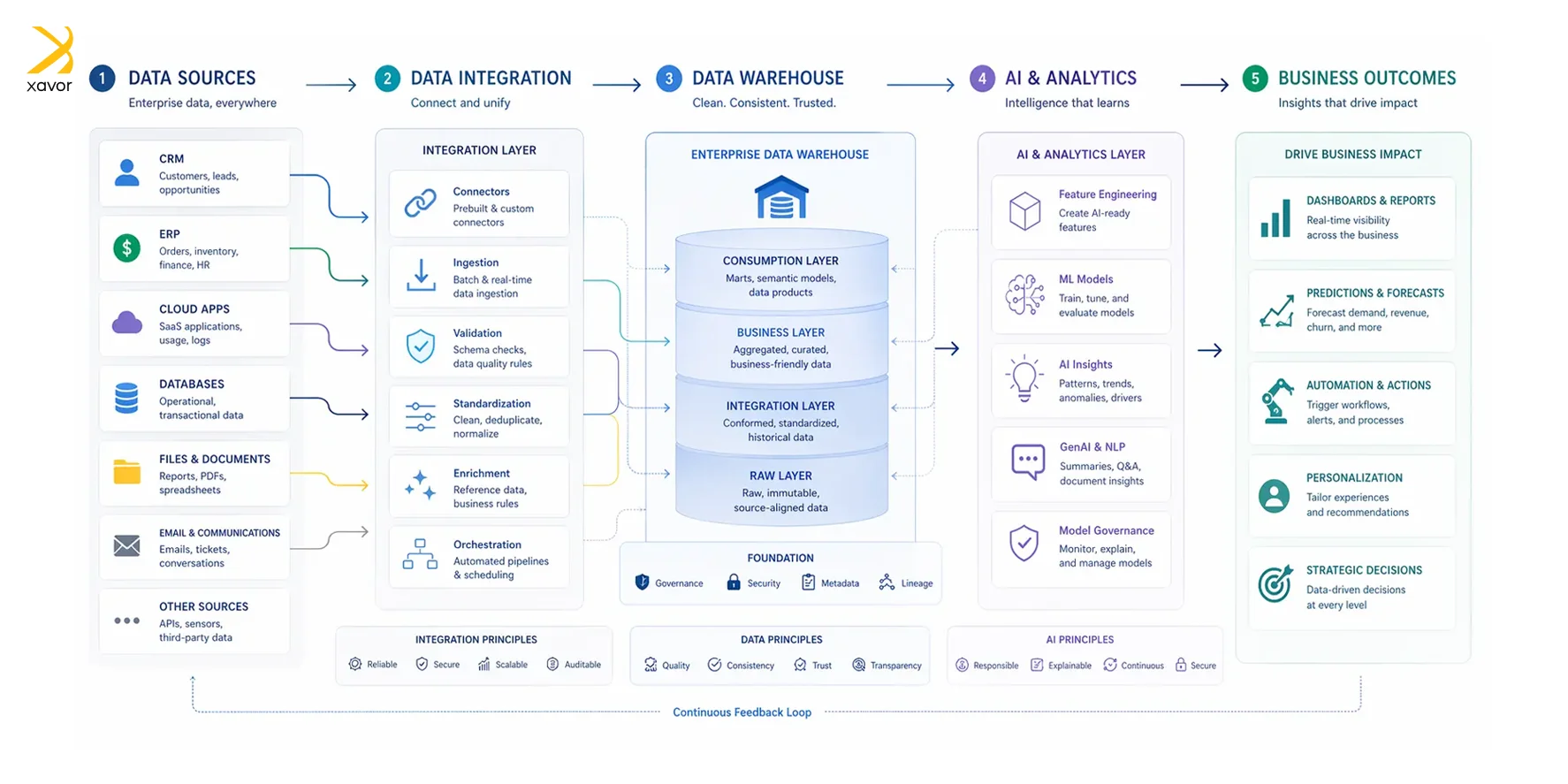
For example, Google positions BigQuery as a platform to “unify your data, connect it to AI” and says its warehouse now spans the path from data to AI to action. AWS similarly says Redshift’s zero-ETL integrations connect operational databases and enterprise apps in near real time.
Data warehouse consulting services make sure an LLM or ML model can ground its outputs in the full business context. A warehouse gives AI one trusted place to retrieve from, train on, or join against.
2. Data warehousing services improve quality and consistency
AI learns from data, so the quality of that data determines the quality of AI outcomes. But AI models don’t automatically know when the data is wrong. So, if your Salesforce data is siloed into different systems with different definitions, a model trained on it learns your inconsistencies.
Data warehousing services clear up this clutter with a single source of truth. They consolidate data first and then standardize it with proper naming and formats.
Moreover, with a data warehouse architecture, you can always validate data at any stage that doesn’t meet the quality standards. Now, better data quality doesn’t automatically mean perfect AI. It means more honest AI that even fails predictably, and in ways humans can diagnose
Data warehousing also improves reproducibility, which is a critical but underappreciated AI requirement. Data warehousing development services implement proper versioning to ensure that every dataset used to train a model is saved and locked at a specific point in time.
3. Organizations can run AI closer to the data to reduce friction
Data warehousing services let companies use AI where the data already lives, instead of constantly moving that data into separate tools or environments.
Traditionally, companies often have to copy large amounts of data out of their warehouse and into another machine learning platform to use AI features. That creates extra steps and more chances for something to break or become outdated.
Now, data warehouse software do more AI work directly inside the warehouse or very close to it. That means they can train models and run AI features without shuffling the data around as much.
This matters in more than one way because:
- Teams spend less time moving and reformatting data before they can use AI
- AI can work on fresher data, so outputs are more up to date
- It is easier to govern data when it stays in the main warehouse
- AI can be deployed quickly because the data foundation is already there
4. Data warehouse services make RAG and conversational analytics practical
The word warehouse gives the impression that data warehouses are mainly for storing data. But as we explained above, data warehousing services help AI use that data in a practical, trustworthy way.
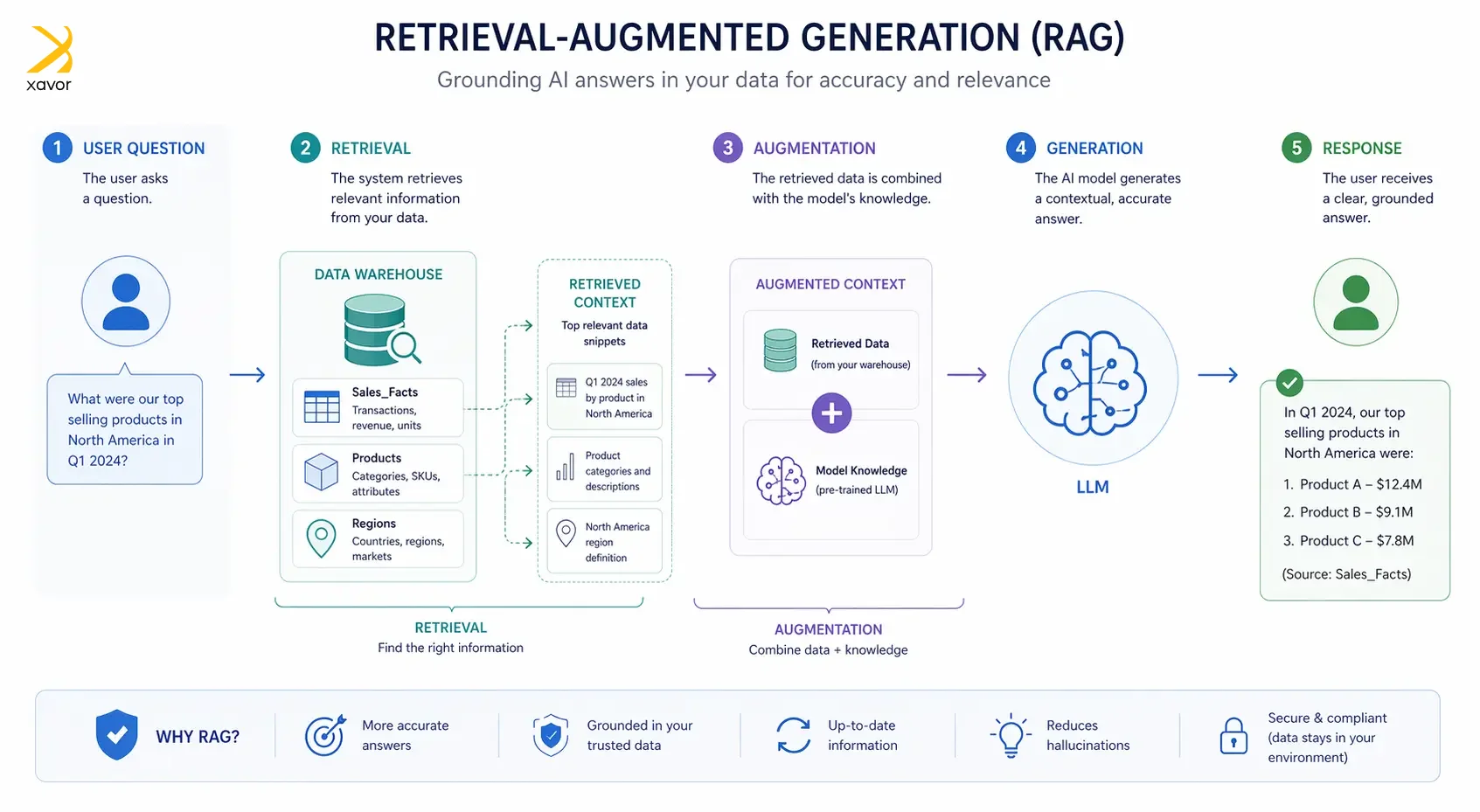
A lot of the most useful business AI does not come from taking an existing model and letting it look up the right company information when needed. That is made possible with retrieval-augmented generation (RAG).
In many companies, the warehouse is the place where the most useful structured business data already lives, such as:
- Sales records
- Customer history
- Orders
- Finance data
- Product usage data
If AI can access that warehouse directly or through connected services, it can answer questions based on the company’s actual information instead of relying only on its general training.
Therefore, data warehousing services implement RAG so that AI can answer with real business context whenever a user asks a question.
More advanced data warehouse development services can combine RAG with conversational AI assistants. That makes your data warehouse an active intelligence layer that agents use to perform actual business tasks in a very accurate fashion.
Real example: How Xavor’s data warehousing services build the AI base
We have worked with a number of clients over the years who needed data warehousing services as part of their AI plans. One thing we noticed with a lot of clients is that they treat data warehouses as storing data for AI only. And not enough on letting AI actually use that data to do work.
That mindset is incomplete and often inhibits AI implementations. Therefore, our teams provide data warehouse consulting that ensures your data is structured and ready to act.
For example, a mid-sized industrial parts manufacturer with operations across three U.S. facilities came to Xavor to build a data warehouse. Their years of operational data were scattered across Salesforce CRM, a legacy ERP, a supplier portal, and three facility-level inventory systems.
During a two-week discovery sprint, our data warehousing services mapped every data source in the client’s environment. We found that the system that owns the data already has an API in nearly every case.
So, Xavor delivered a lightweight orchestration data warehouse architecture built on three pillars:
1. API connectors
Xavor built direct connectors between the client’s live systems using a combination of MCP-compatible integration services and custom API middleware.
2. Targeted AI agents
Three purpose-built agentic AI models were deployed, each mapped to one of the three operational decisions the client had identified.
3. A data warehouse
Not everything could run on live data. Demand forecasting and trend analysis genuinely needed historical depth. For such use cases, we built a lean, purpose-scoped data warehouse. It was a curated set of tables fed only by the data those specific models needed.
Within months of go-live, the client’s inventory-related stockouts dropped by 60%. And quote response time fell from an average of 2.3 days to under four hours.
Conclusion
Shifting your enterprise to AI is concomitant with setting up a solid data foundation. Your data needs to be centralized and easily accessible for AI to do meaningful work. And a data warehouse is a major part of making that possible.
That is why partnering with data warehousing services for AI transformation is a sound investment. They warp and weft your data infrastructure into a fabric that AI can actually work with.
Xavor’s data warehousing services work with your team to design AI-ready data pipelines. We make sure your foundation is built for what comes next.
Contact us at [email protected] to book a free consultation session.
About the Author

Usama is a Principal Software Engineer in the Data Science team at Xavor, specializing in cloud-based data platforms and analytics. He leads scalable data and BI solutions on GCP, with expertise in big data transformation, machine learning, and delivering insight-driven systems for global enterprise clients.
FAQs
Data warehouse services help organizations collect, integrate, and organize data from multiple sources into a centralized system for analysis and reporting. They ensure data is clean, structured, and reliable. This foundation enables better decision-making, analytics, and AI use cases.
The four common types of data warehouses are: 1) Enterprise Data Warehouse (EDW): A centralized system that stores all organizational data for company-wide analysis. 2) Operational Data Store (ODS): A system for real-time or near real-time data used in day-to-day operations. 3) Data Mart: A smaller, department-specific subset of a data warehouse. 4) Cloud Data Warehouse: A scalable, cloud-based solution designed for modern analytics and AI workloads.
An example of data warehousing is a retail company combining sales data from stores, online orders, and inventory systems into a central database. This allows the business to analyze trends, track performance, and make better decisions based on unified data.
(The following story may or may not have been edited by NEUSCORP.COM and was generated automatically from a Syndicated Feed. NEUSCORP.COM also bears no responsibility or liability for the content.)